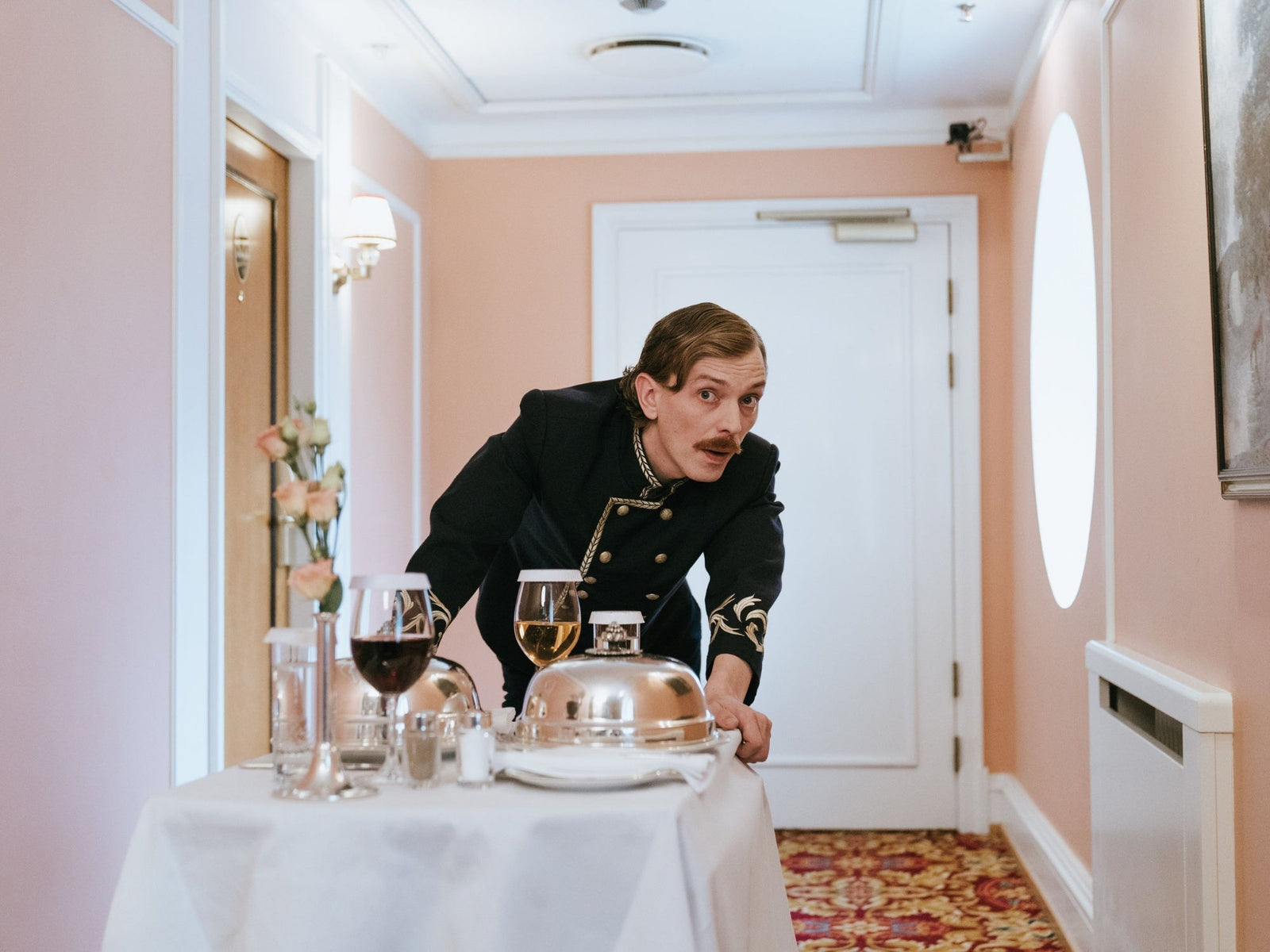
Why Viennese waiters seem so unfriendly – and often aren't at all
Why Viennese waiters aren't unfriendly – they just don't have time for your feelings
You enter a Viennese coffee house, sit down at a free table, and wait. The waiter has seen you. Definitely. Your gazes even met briefly. Yet, at first, nothing happens.
Eventually, he comes. No "Hi guys, how are you today?", no introduction by first name, and probably no effusive enthusiasm about your order. Instead, a curt "Bitte?" and an expression that makes a Vienna newcomer wonder if they've already done something wrong.
Usually, you haven't.
Because what visitors occasionally perceive as unfriendly service is part of a very unique Viennese tradition. The classic Viennese waiter is not your new best friend. He is a host, an authority, an observer, and sometimes a master of dry "Schmäh" (wit). Once you understand this, the Viennese coffee house suddenly feels completely different.
Are Viennese waiters really unfriendly?
No – at least, traditional Viennese service culture cannot simply be explained as "unfriendly." What may initially seem reserved or distant often follows a different idea of hospitality: Professionalism does not have to be accompanied by demonstrative warmth.
In many international restaurants, it's part of the service to regularly ask if everything is okay. In a classic Viennese coffee house, good service can mean exactly the opposite: You are left in peace.
You can read your newspaper, work, discuss, or sit in front of the same Melange for an hour without someone asking every five minutes if you want to order something else.
Actually, quite luxurious.
You just have to understand first that peace can also be service.
The Viennese waiter is an institution
Even the name reveals a lot. In a traditional coffee house, people often refer to the Ober (senior waiter) – and not just simply the Kellner (waiter). Historically, this role holds a special significance within Viennese coffee house culture.
The classic Ober knows his establishment, his regulars, and the routines. He moves through the room with a self-assurance that makes it clear: You are a guest here, but he knows how this place works.
The relationship is therefore different from a restaurant that aims to stage maximum customer orientation. The guest may be king.
But the Ober remains emperor.
Why doesn't the waiter come immediately?
One of the first tests for inexperienced coffee house visitors is the waiting time.
You sit.
You look.
You try to make eye contact.
The waiter walks by.
Did he not see you?
He did.
Very likely, even.
However, a traditional Viennese coffee house doesn't necessarily follow the rhythm of modern system gastronomy. The idea is not to get you to order, consume, pay, and vacate the table as quickly as possible.
The coffee house thrives precisely because time plays a different role.
Of course, bad or slow service also exists in Vienna. Not every waiting time is a cultural asset. But the famous Viennese nonchalance in serving certainly fits a place where guests traditionally are allowed to stay longer.
So, don't get nervous.
He'll come.
Probably.
Friendliness sometimes sounds different in Vienna
Those who equate friendliness with a constant smile might experience a small culture shock in Vienna.
Here, a curt "Bitte sehr" (You're welcome/Here you go) can be meant in a completely friendly way. A dry comment can express sympathy, and a waiter who greets you with your usual order after several visits might show more personal attention than someone who asks you five times an evening if "everything is amazing."
Viennese warmth is often less visible.
It hides in small details.
They remember your coffee. They bring you the newspaper. They know which table you prefer. And perhaps, at some point, there'll even be a little bit of "Schmäh" (witty banter) thrown in.
By then, at the very latest, you can feel almost honored.
When the waiter cracks a joke
Viennese "Schmäh" and the coffee house have long belonged together. A good waiter can tease a guest with a single dry sentence without actually being rude.
The crucial thing is the fine line.
Schmäh plays with the guest instead of embarrassing them. The answer comes quickly, seems casual, and is often so dry that it takes a moment to realize a punchline has just landed.
For visitors, this can be unfamiliar. Anyone who takes every word literally might think the waiter is grumpy.
Those who recognize the undertone begin to laugh.
And that's where it gets interesting.
Why no one in a Viennese coffee house wants your table back
At least not immediately.
One of the most beautiful peculiarities of traditional Viennese coffee house culture is the idea that you don't just pay for the drink. With the Melange, you essentially buy the right to be there for a while.
Historically, coffee houses were places for reading, writing, discussing, and observing. Newspapers were just as much a part of it as regulars who spent a significant part of their day at the same table.
This attitude can still be felt in many classic establishments today.
You don't have to jump up immediately after the last sip. And the waiter doesn't have to constantly prompt you for new orders.
You leave each other in peace.
Perhaps that is one of the most pleasant forms of mutual respect.
What you should rather not do in a Viennese coffee house
The good news first: You don't need an etiquette course to order a coffee in Vienna. Nevertheless, it helps not to treat the coffee house like an international coffee shop chain.
A friendly "Bitte" (please) and "Danke" (thank you) work wonderfully. If it's busy, a little patience is helpful. And if you want to pay, signal that to the waiter instead of waiting for the bill to magically appear.
Above all, you don't have to imitate the Viennese dialect.
Nobody expects a visitor to suddenly shout "Herr Ober, an Verlängerten!" (Waiter, an extended coffee!) across the room.
Just order what you want.
The "Schmäh" (witty banter) will come later.
Grumpy or just Viennese?
Of course, one must also draw a line. Not every unfriendly service is suddenly a valuable piece of Viennese cultural heritage.
If someone is treated disrespectfully, that remains poor service. The famous "grumpy waiter" should not be a license to romantically market genuine rudeness as tradition.
More interesting is the gray area before that.
Viennese service can be more reserved, direct, and less emotionally staged than what visitors from other countries are used to. Precisely this distance is quickly interpreted as grumpiness, although sometimes it simply means: You get your coffee – and then you are left in peace.
The regular customer doesn't necessarily get more friendliness
Perhaps the most beautiful thing about the classic Viennese waiter: If you become a regular, you shouldn't necessarily expect a completely new personality to emerge.
Perhaps they know your name.
Perhaps your order.
Perhaps you'll get a dry comment even before you've taken off your jacket.
That's progress.
Because in Vienna, familiarity doesn't necessarily manifest in people becoming politer to each other. Sometimes the exact opposite happens.
If the waiter starts to engage in a bit of "Schmäh" with you, you might just have arrived.
How to order correctly in a Viennese coffee house?
Much simpler than some guidebooks might suggest. Sit down, unless otherwise specified in the establishment, wait for the waiter, and order your coffee. A simple "Eine Melange, bitte" (A Melange, please) is perfectly sufficient.
And then?
Stay seated.
Look around. Read something. Talk. Observe the coffee house. Perhaps even briefly resist the urge to immediately check your phone.
Because someone who just goes in, drinks a coffee, and leaves after twenty minutes has indeed drunk coffee.
But they haven't necessarily understood the coffee house.
Perhaps that's real luxury
Modern gastronomy has accustomed us to equating attention with good service. Someone greets us, explains the concept, asks about our well-being, and wants to know if everything is truly perfect.
The Viennese coffee house offers an almost radical alternative.
It leaves you in peace.
The waiter doesn't have to become your friend. You don't have to impress him. Nobody has to pretend that your Melange is the most exciting event of the day.
You get your coffee, a glass of water, and above all, something that has become astonishingly rare in an increasingly fast-paced city:
Time.
Perhaps that's why Viennese waiters aren't so unfriendly.
Perhaps they have simply understood that good service sometimes consists of not asking someone for a while if everything is okay.
And if the waiter still has a dry remark for you when you pay?
Even better.
Then he was probably quite satisfied with you.