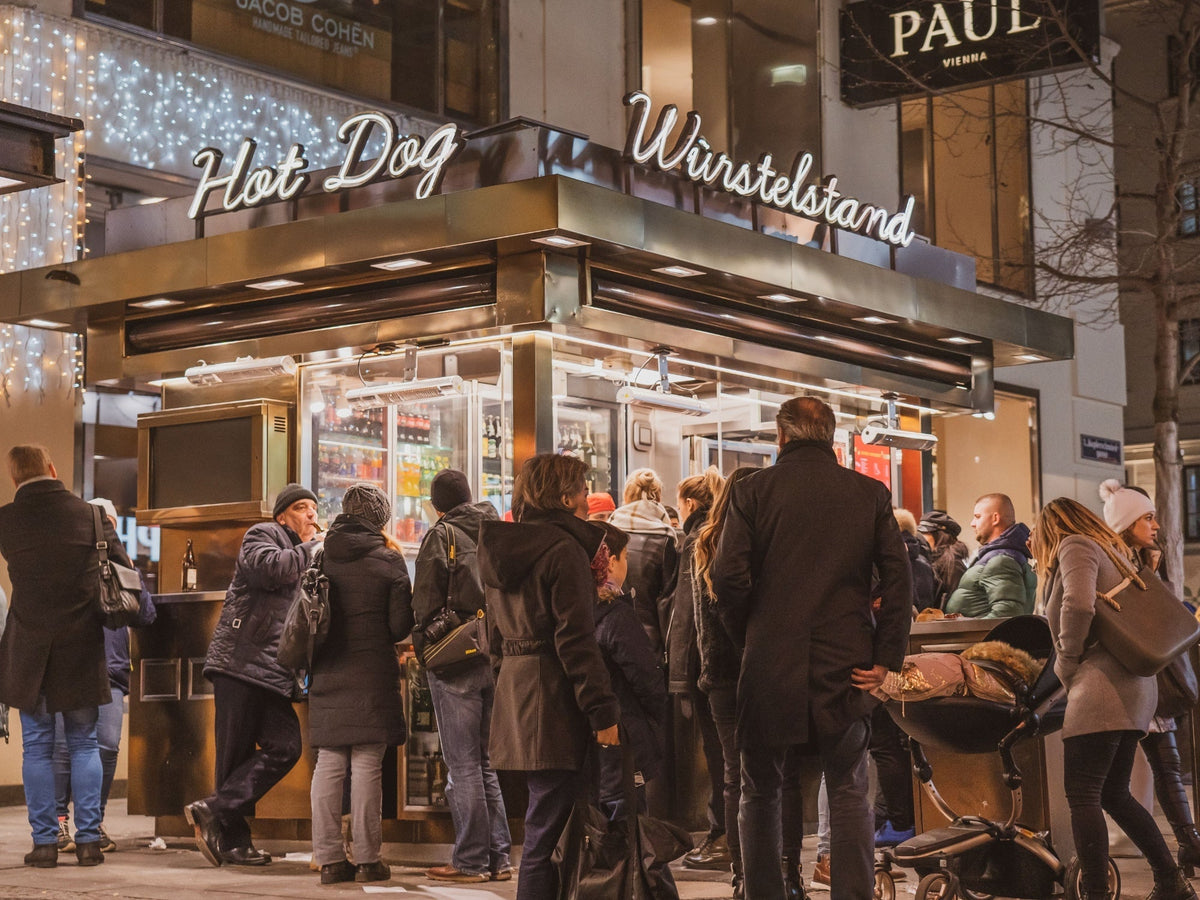
Viennese sausage stand: Why it's a cult classic at night
The Sausage Stand at 2 AM: Vienna's Most Democratic Place
It's two o'clock in the morning in Vienna. In front of you, someone in a suit is ordering a Käsekrainer, behind you is a group of students, next to them a taxi driver is waiting for his coffee, and somewhere someone has been trying for five minutes to explain why Rapid is definitely – really definitely – going to have an excellent season this year.
No one has a reservation. No one gets the better table. Strictly speaking, there often isn't even a table.
Welcome to the Viennese sausage stand.
During the day, it's a snack bar, a meeting point, and a quick fix for hunger. At night, however, something more interesting happens: people who would rarely meet in normal Viennese everyday life suddenly stand shoulder to shoulder in front of the same small sales window. For a few minutes, profession, income, and social status play surprisingly little role.
In the end, everyone wants the same thing anyway.
A Käsekrainer.
Maybe a beer too.
And as much mustard as possible.
Why the Sausage Stand is Part of Vienna
The Viennese sausage stand is much more than a place for fast food. It is part of the city's everyday culture – as natural as a coffee house, a Beisl (traditional Austrian pub), or a tram. Historically, the mobile sales stands developed in the late 19th century partly as a means of earning a living for war veterans; later, permanent sausage stands became part of Vienna's streetscape.
Today, you can get classics like Frankfurter, Käsekrainer, Burenwurst, or Bratwurst, along with mustard, horseradish, bread, or a Semmerl (bread roll). But anyone who explains the sausage stand solely by its menu misses what's truly interesting.
Because its most important piece of furniture is not the grill.
It's the counter.
Why the Sausage Stand Becomes a Different Place at Night
At two in the morning, Vienna changes. Offices are closed, shops have long been dark, and even most coffee houses have said goodbye to their last guests. But then begins the golden hour of places where no one wants to know if you had a productive day.
The sausage stand is one of them.
After a concert, someone stands here next to a person who has just finished their shift. The opera-goer meets the clubber, the tourist meets the regular, the taxi driver meets someone who urgently needs to eat something before driving home.
Everyone orders through the same window.
Everyone eats standing up.
And no one can look particularly important with a Käsekrainer in hand.
Perhaps that is its democratic moment.
The Käsekrainer: Vienna's Answer to the Question "Want to eat something else?"
If there's an unofficial queen of the nocturnal sausage stand, it's probably the Käsekrainer. The smoked boiled sausage with embedded cheese pieces is one of the most famous classics of Austrian sausage stand culture.
It's ordered plain with mustard and bread, sliced, or in a roll. And of course, there are people who have very precise ideas about which variant is the only correct one.
As with almost all culinary questions in Vienna, it's advisable not to try and resolve this discussion.
Just eat.
"A Eitrige mit an Buckl" – When Ordering Becomes a Viennese Test
A small vocabulary of its own exists around the sausage stand. The humorous term "Eitrige" for Käsekrainer is particularly famous. Depending on the stand, generation, and enjoyment of Viennese dialect, you'll also encounter all sorts of vivid expressions for bread, mustard, or other parts of the order.
For visitors, it quickly sounds like a secret code.
However, you don't have to use it.
On the contrary: if you're in Vienna for the first time, you can perfectly well order "Eine Käsekrainer mit Senf und Brot, bitte" (A Käsekrainer with mustard and bread, please). The sausage stand is not a language test.
If you listen long enough, you'll learn Viennese incidentally anyway.
And that's usually more charming than ordering an "Eitrige" with maximum dialect after two days of staying.
The Counter Knows No Seating Arrangement
In a restaurant, the reservation dictates where you sit. In a coffee house, the empty table decides. In a club, there are guest lists, sections, and sometimes even different categories of people who get in at different speeds.
At the sausage stand, there's the counter.
Whoever finds a spot first stands there.
This creates an unusual proximity. You hear conversations that weren't actually meant for you. You might comment on the football game, the weather, or the astonishing amount of mustard your neighbor is using. And sometimes, a completely trivial sentence starts a conversation with someone you'll never see again five minutes later.
The sausage stand is thus one of the few places in the city where strangers still stand relatively naturally next to each other, without anyone having to turn it into a networking event.
Sausage Stand and Viennese Charm Go Hand in Hand
Of course, a Viennese sausage stand without "Schmäh" (Viennese charm/wit) would only be half as interesting.
Communication is direct. Orders are processed quickly, regulars are recognized, and occasionally a dry comment flies over the counter. Not every stand is the same, not every vendor is a born comedian – but the informal atmosphere creates the perfect habitat for Viennese Schmäh.
This works particularly well because little is staged at the sausage stand.
No one expects a detailed explanation of the ingredients. No one needs a story about which alpine pasture the mustard emotionally matured on.
You order.
You get your food.
Maybe there's a witty remark to go with it.
Perfect.
Is the Viennese Sausage Stand Really a Place for Everyone?
Of course, "Vienna's most democratic place" is an exaggeration. Even a sausage stand is not a social utopia, and not every Viennese spends their nights there.
But hardly any other gastronomic establishment reduces social differences so visibly to a minimum. There's no seating arrangement, no dress code, and usually no hours of reservation planning.
The product is the same for everyone.
The CEO doesn't get a more exclusive Käsekrainer than the student next to him.
And perhaps that's democratic enough for two in the morning.
Why the Sausage Stand is More Than Viennese Fast Food
One could easily call a sausage stand fast food. The food is quick, uncomplicated, and meant for on-the-go.
Culturally, however, that falls short.
Because a classic sausage stand fulfills a similar function to other traditional Viennese institutions: it is a social space. Just without marble tables, newspaper holders, and Thonet chairs.
The coffee house belongs to the afternoon.
The Beisl to the evening.
And sometime late at night, the sausage stand takes over.
There, no one needs a reason to go. Hunger is perfectly sufficient.
What to Order at a Viennese Sausage Stand?
If it's your first time looking at the menu, don't overthink it. Classic offerings, depending on the stand, include Käsekrainer, Frankfurter, Bratwurst, and Burenwurst. These are usually accompanied by mustard, horseradish, bread or rolls, and drinks.
The simplest strategy is the best anyway: look at what the particular stand offers, and order what you fancy.
There's no compulsory secret phrase that real Viennese must recite.
And no, you don't have to try and suddenly speak dialect either.
A friendly "Bitte" (please) has worked for an astonishingly long time.
Why Two O'Clock in the Morning Might Really Be the Best Time
Of course, you can go to the sausage stand at lunchtime. You can eat a quick Käsekrainer in the afternoon and then move on, perfectly satisfied.
But at night, you understand the place differently.
Then the pure purpose of a quick lunch disappears, and the sausage stand becomes the city's last common stopover. For some, the evening ends there; for others, the journey home begins; still others have just finished work.
These different versions of Vienna meet for a few minutes.
Perhaps no one talks to each other.
Perhaps half the counter suddenly discusses something.
Both work.
The Sausage Stand is Vienna in a Few Square Meters
If you want to understand Vienna, you can go to a museum, stroll through the Hofburg, or spend an afternoon in a coffee house.
But at some point, you should also stand at a sausage stand at night.
Not just for the Käsekrainer.
But because much of what makes this city comes together here: directness and charm, tradition without much ceremony, a bit of grumbling, and the surprising ability to make oneself comfortable even while standing.
At two in the morning, no one particularly cares where you just came from.
Opera or club.
Office or Beisl.
First date or last drink.
You stand in front of the same window, waiting for the same order, and trying not to get mustard on your jacket.
Perhaps that's why the Viennese sausage stand is indeed one of the city's most democratic places.
At least until someone orders the last Käsekrainer before you.